
Blended Learning, Domestic, Faculty, Faculty, Flipped Classrooms, For-Profit, Required, Startups, Universities & Colleges - Written by Wired Academic on Friday, November 18, 2011 8:46 - 2 Comments
Sloan Survey: Online Enrollment up 10% to 6.1 Million Students
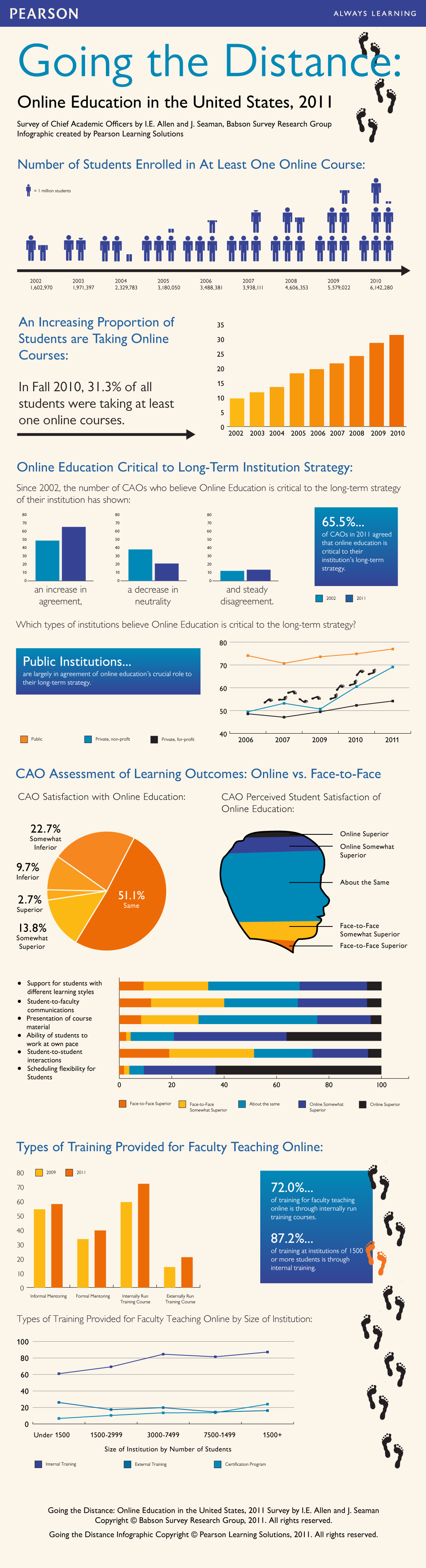
The annual Sloan survey of online education - Going The Distance - is out now. It shows continued, dramatic growth in online courses nationwide. Take a look at the highlights:
- Over 6.1 million students were taking at least one online course during the fall 2010 term, an increase of 560,000 students over the previous year.
- The 10% growth rate for online enrollments far exceeds the 2% growth in the overall higher education student population.
- Thirty-one percent of higher education students now take at least one course online.
- Reported year-to-year enrollment changes for fully online programs by discipline show most are growing.
- Academic leaders believe that the level of student satisfaction is equivalent for online and face-to-face courses.
- 65% of higher education institutions now say that online learning is a critical part of their long-term strategy.
- There continues to be a consistent minority of academic leaders concerned that the quality of online instruction is not equal to courses delivered face-to-face.
“The rate of growth in online enrollments is ten times that of the rate in all higher education” said study co-author I Elaine Allen, Co-Director of the Babson Survey Research Group and Professor of Statistics & Entrepreneurship at Babson College. “While growth rates have declined somewhat from previous years, we see no evidence that a dramatic slowdown in online enrollments is on the horizon.”
Previously underwritten by the Alfred P. Sloan Foundation, the report has been able to remain independent through the generous support of Pearson, Kaplan University, Inside Higher Ed and the Sloan Consortium. Here’s a link to the full Sloan Report for 2011.

2 Comments
Online courses are a good indication of future learning. Some adults may not be able to attend a traditional university due to family or work obligations. Open coursework will allow them to continue learning at a potential lower cost versus a traditional classroom setting.
Leave a Reply
Campus Buzz
We welcome Tips & Pitches

Latest WA Original Features
-
“Instreamia” Shakes Loose Moss By Launching Spanish Language Mini-MOOC
-
Jörn Loviscach: A German Math Teaching Sensation Emerges On YouTube & Udacity
-
Open University Enters Battle Of The MOOCs, Launches “FutureLearn”
-
Alvaro Salas As A Case Study In Crowd-Funding An Ivy-League Education
-
Jonathan Mugan: How To Build A Free Computer Within A Computer For Your Child
Paul Glader, Managing Editor
@paulglader
Eleni Glader, Policy Editor
Elbert Chu, Innovation Editor
@elbertchu
Biagio Arobba, Web Developer
@barobba
Contributors:
Michael B. Horn
@michaelbhorn
Derek Reed
@derekreed
Annie Murphy Paul
@AnnieMurphyPaul
Frank Catalano
@FrankCatalano
Ryan Craig
@UniVenturesFund
Jonathan Mugan
@JMugan
Terry Heick
@TeachThought
Alison Anderson
@tedrosececi
Ravi Kumar
@ravinepal

The Pulitzer Prize winning investigation newsroom digs into for-profit education.
-
Most Viewed
- Inside Ashford University: A former staffer talks to WiredAcademic
- Infographic: A History Of Information Organization From Stone-Age To Google
- Davos: 12-Year-Old Pakistani Prodigy Girl Talks About Her Online Learning
- Open University Enters Battle Of The MOOCs, Launches "FutureLearn"
- Pearson Llc + Google Expands LMS Business With "OpenClass" System
-
MARKET INTRADAY SNAPSHOT
- Education & Tech Companies We Follow
| APEI | 40.20 |  -0.17 -0.17 | -0.42% | ||
| APOL | 19.01 |  +0.33 +0.33 | +1.77% | ||
| AAPL | 460.16 |  -6.43 -6.43 | -1.38% | ||
| BPI | 10.74 |  -0.09 -0.09 | -0.83% | ||
| CAST | 0.11 |  +0.01 +0.01 | +10.00% | ||
| CECO | 4.08 |  -0.02 -0.02 | -0.49% | ||
| COCO | 2.40 |  -0.02 -0.02 | -0.83% | ||
| CPLA | 32.03 |  -0.41 -0.41 | -1.26% | ||
| DV | 30.69 |  +0.36 +0.36 | +1.19% | ||
| EDMC | 4.03 |  +0.07 +0.07 | +1.77% | ||
| ESI | 18.34 |  +0.04 +0.04 | +0.22% | ||
| GOOG | 792.89 |  +5.07 +5.07 | +0.64% | ||
| LINC | 6.20 |  +0.06 +0.06 | +0.98% | ||
| LOPE | 25.03 |  +0.36 +0.36 | +1.46% | ||
| PEDH | 0.45 |  0.00 0.00 | +0.00% | ||
| PSO | 18.51 |  -0.27 -0.27 | -1.44% | ||
| SABA | 8.61 |  -0.16 -0.16 | -1.82% | ||
| SCHL | 30.87 |  +0.46 +0.46 | +1.51% | ||
| STRA | 51.95 |  -1.54 -1.54 | -2.88% | ||
| WPO | 414.41 |  +5.35 +5.35 | +1.31% |
Domestic, For-Profit, Gainful Employment, Infographics, Personalized Learning, Private, Public, Required, Universities & Colleges - Jan 31, 2013 6:09 - 0 Comments
Infographic: To Get A Degree Or Not To Get A Degree? Here Is An Answer
More In For-Profit
- Ryan Craig: American Clampdown Forcing Forlorn For-Profit Colleges To Look Abroad
- How For-Profit Colleges Major In Marketing & Fail Education
- Infographic: A Graphical Profile Of Today’s Online College Student
- Infographic: A Comparison Of For-Profits v. Non-Profit Online College Data
- Opinion: How “Shareholder Value” Is Destroying For-Profit, Career Colleges
Cost of Education Domestic Education Quality Ethics For-Profit Friend, Fraud, or Fishy Gainful Employment Graduation Rates Legislation Minorities Opinion Recruitment Regulatory Required Retention Rates Student Loans Universities & Colleges
MOOCs, Required, Technology - Feb 16, 2013 10:04 - 0 Comments
MOOC Monitor: Must Reads This Week
More In Technology
- Infographic: Rise of the MOOCs
- Smart Cities Part II: Why DC Is The Planetary Hub Of Online Learning
- Five Questions: Polling EdTech Startup UnderstoodIt’s Liam Kaufman
- Infographic: The Future of Higher Education
- Anne Collier: Study Shows eBooks Gaining Larger Share & Boosting Overall Reading Habits
Domestic K-12 Parents Reading / Literature Required Technology
Charter, Cost of Education, Domestic, Education Quality, Friend, Fraud, or Fishy, K-12, Minorities, Regulatory, Required - Feb 7, 2013 12:23 - 0 Comments
Should For-Profit Companies Manage K-12 Schools? A Skeptical Review
More In Friend, Fraud, or Fishy
- A Letter To Sen. Tom Harkin About For-Profit Charter Schools
- Ryan Craig: American Clampdown Forcing Forlorn For-Profit Colleges To Look Abroad
- Opinion: The Problem With Deceptive Degree Aggregators In The Search For Online Courses & Degrees
- How For-Profit Colleges Major In Marketing & Fail Education
- Infographic: A Comparison Of For-Profits v. Non-Profit Online College Data
Cost of Education Domestic For-Profit Friend, Fraud, or Fishy Graduation Rates Infographics Recruitment Required Universities & Colleges


10 %v increas is nothing. In the past it was 20 -24 % per year .
In fact the measure is not a good and right one .
” Number of students who take at least one online course .. ” meanningless.
The real measure is ” how many online courses were taken last year in total . ”
Let us assume the equevalent of full time students in the USDA is 18 million .
Since full timers take 10 courses per year then total courses taken per year is 180 million .
Ho0w many of those 180 million courses are ONLINE . That is the measure
Another concept to be measured is
How many fully online programs USA has and how many students are in there ?
Fully online means students do not enter the campus at all .