

Education Nation: Program Strives To Create Next-Generation Engineers & Math Talent
By Wired Academic on October 2, 2012
Domestic, K-12, Legislation, Public, Regulatory, Required, STEM, Teachers, Universities & Colleges
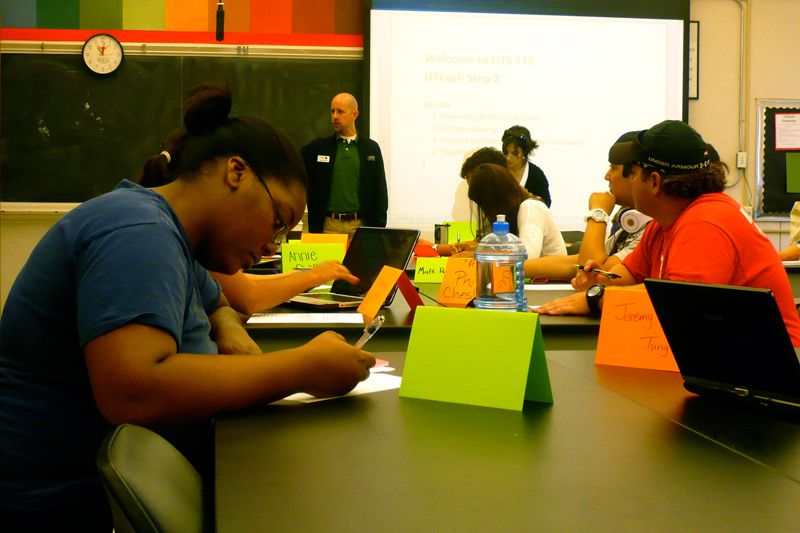
Math and science majors at the University of Texas-Austin begin the second semester of a program training them to be high school teachers. (Photo by Sarah Garland)
By Sarah Garland, The Hechinger Report
It was the first day of class, and Chris Costello’s instructions to a group of college students in a science building at the University of Texas-Austin were evoking giggles.
“Imagine you’re a third-grader,” Costello, a teaching assistant, told the class. “What’s something that can fly?”
“Superman!” one student called out. “A bird,” said another. “A fly,” a third shouted.
Next, Costello and the course instructor, Shelly Rodriguez, handed out worksheets and brightly colored safety scissors. The students cut out and folded origami “helicopters” and set about throwing them in the air, noting how fast and in which direction they spun.
The lesson was the difference between independent and dependent variables in scientific experiments, a concept that most students in the class – which included chemistry, biology and mechanical-engineering majors — had mastered long ago. But the point was not for these college students to learn something new about variables; it was to help them decide whether they wanted to take their knowledge and pass it on.
“As math and science people, we don’t always see ourselves as teachers, but I hope you’ll keep an open mind,” said Rodriguez, who, like Costello, is a former high school teacher.
Her pitch was the first step in a special program at the University of Texas known as UTeach, an effort to entice talented math and science majors who might otherwise become doctors or engineers to choose teaching instead. It was developed in answer to a growing crisis in American education.
For more than a decade, educators have been sounding an alarm about the dismal performance of American students in math and science. They cite grim statistics: Less than a third of eighth-graders scored proficient in science on the National Assessment of Student Progress in 2011 and slightly more than a third passed in math.
As a result, the United States is also quickly losing its status as a world leader in science and technology, according to a landmark report published in 2005 by The National Academies, a nonprofit research group. In 2008, approximately 5 million undergraduate degrees were awarded in science and engineering. Of those, Chinese students accounted for 23 percent, European Union students earned 19 percent, and the United States only 10 percent.
This summer, the Obama administration announced plans to create a new master teaching corps in science, technology, engineering and math, known as STEM studies. Educators, along with the Obama administration, are also increasingly embracing UTeach, which has spread to 34 universities in 16 states. In the 2005 National Academies report, UTeach was cited as a model that could “transform the quality of our science and mathematics teaching.” Last year, Congress passed the America COMPETES Act, which includes funding to replicate the UTeach model in other universities.
UTeach was conceived in 1998, when a group of high school teachers and professors at the University of Texas-Austin gathered to discuss what to do about the state of STEM education in local schools. Although occasionally college professors and students would visit local K-12 classrooms to teach a lesson or two, these were “not durable solutions,” recalls Michael Marder, a physics professor at the university.
“There are large (teacher) shortages” in math and science classes in high school, Marder said. “This was clearly a place where the university was well placed to make changes.”
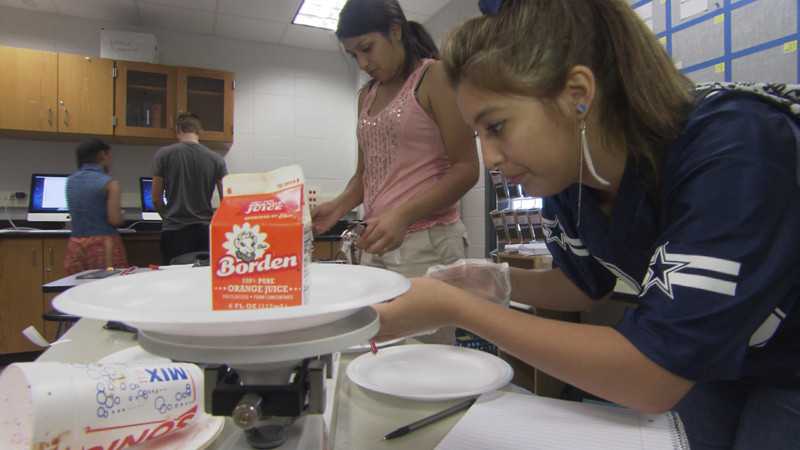
Mary Ann Rankin, then-dean of the university’s College of Natural Sciences, invited the high school teachers to come up with their ideal program for training new math and science teachers — the kind they wished they had before entering the classroom. Professors from both the education school and from the math and science departments then tweaked that curriculum.
The result was a series of courses that combine practicalteaching experience — before committing to the program, students must teach lessons at a real school to see if they like it – with educational, mathematical and scientific theory.
“We wanted to change it so they weren’t taking generic education classes, but what … you need to teach math and science,” said Mary Walker, a former high school chemistry teacher who helped design the UTeach curriculum.
Traditionally, education colleges have trained math and science teachers, in contrast to the partnership between the math, science and education faculties in the UTeach program. The curriculum is intense, but also relatively condensed. It is also heavily focused on inquiry-based teaching, which means fewer lectures and more student led group work, like the helicopter exercise, and longterm projects.
Administrators say the program has exceeded expectations.
Between 2000 and 2011, 746 students graduated from the UT-Austin program (only nine students graduated in the first cohort). The total national enrollment in UTeach programs is now 5,574. And more than 80 percent of alumni are still in the classroom after five years — an impressive number, considering that half of teachers nationally leave the profession in that period.
Some evidence suggests that UTeach alumni are improving the performance of their students, administrators say. UTeach administrators observe new teachers once they enter the classroom, says Marder, who is now co-director of the program. The program has not published the data, however.
Manor New Tech High School, in a small town just east of Austin, offers more evidence that the program can improve student achievement. The school opened in 2007 with a math and science faculty comprised entirely of UTeach alumni. So far, the school has performed above average on state math and science tests and graduated nearly all of its students, half of whom qualify for free or reduced-price lunches available to low-income students. And 100 percent of those who graduate go on to college, says the principal, Steven Zipkes.
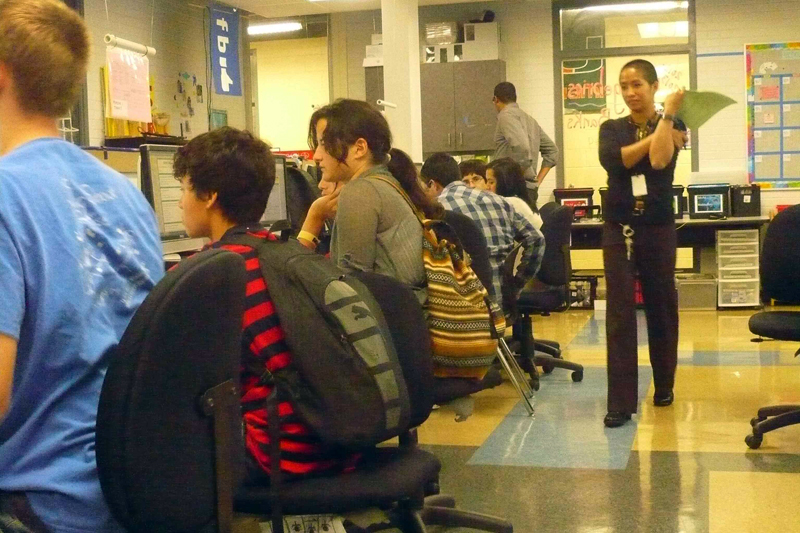
“We have more room to be creative. I like that we’re allowed to do independent work,” said Dharma Casey, a 14-year-old freshman in a biotechnology class taught by UTeach alum Stephanie Hart. It’s a contrast to her middle school experience, she added. “We did a lot of stuff out of the book last year.”
It’s UTeach’s focus on making discovery and creativity integral to the study of math and science that has drawn in many new teachers who might have gone on to more prestigious or better-paid jobs. Janice Trinidad, a teacher at Manor New Tech who has a Ph.D. in physics, says her own education was mostly lecture classes that were “very teacher centered.”
“There are some students in this school who wouldn’t have survived the way I was taught,” she said.
EDUCATION NATION
This story was produced by The Hechinger Report, a non-profit, independent journalism organization housed at Columbia University in New York. It is part of a series written in collaboration with NBC for the annual Education Nation summit.
- Read the rest of our stories in the series
- Check out an interactive version of the story
- Visit NBC’s Education Nation page
In a previous version of this story, data about the performance of UTeach alumni was misstated. Data has not been published about the effectiveness of UTeach alumni in the classroom.
Related Posts
- The STEM Of Innovation: What Makes A Good Science Teacher?
- Why STEM Matters: Texas Educators and Experts Sound Off On The STEM Shortage
 Federal Turnaround Funds Force New Methods For Evaluating Teachers
- Interview: David Drew on Broadening STEM Education & Debunking Its Myths
- India Kicks Off A College Building Boom To Boost National Development


Tips & Pitches
Latest WA Features
-
Online Courses Are Expanding, Along With Questions About Who Owns The Material
-
Why Size Matters: Consolidation Sweeps Across US Higher Ed
-
Trend: Corporate U Employers Offering Just In Time Education To Workers
-
Subterfuge & Skullduggery In The College Rankings Game
-
“Instreamia” Shakes Loose Moss By Launching Spanish Language Mini-MOOC
Domestic, Education Quality, For-Profit, Friend, Fraud, or Fishy, K-12, Legislation, Opinion, Personalized Learning, Regulatory, Required, Universities & Colleges - Apr 29, 2014 - 0 Comments
Michael Horn: NCAA March Madness Followed By April Blunder In Online Learning
More In For-Profit
- The Economy Is Forcing Tuition To Fall Rapidly At Private, For-Profit Colleges
- Kamenetz: Jeb Bush As Controversial Leader Of Aspen Task Force on Learning & The Internet
- Columnist Ryan Craig: The Best Of Times Could Return As For-Profit Edu Invests
- Bubble Analysis: Trace Urdan on Why This Era of Ed Investing Could Be Different
- A Blended Path? How American Honors Cuts Cost of Four Year Degree by Over a Third
Community Colleges Cost of Education Domestic For-Profit Required Student Loans Universities & Colleges
Blended Learning, Domestic, Education Quality, Gamification, K-12, Open Source Education, Required, Startups, Technology - May 22, 2015 - 0 Comments
iCivics: Video Games as Middle School Social Studies Curriculum
More In Technology
- Online Education As A Postmodern Societal Response
- MakerBot Academy: A 3-D Printer In Every Classroom
- Michael Horn: A Look Behind The Curtain At How A MOOC Is Made
- Koller, Khan and Agarwal At The NYT’s Schools of Tomorrow Conference
- Video: New NESTA Report, Three Steps To Assess Digital Innovation in Education
Domestic, Education Quality, For-Profit, Friend, Fraud, or Fishy, K-12, Legislation, Opinion, Personalized Learning, Regulatory, Required, Universities & Colleges - Apr 29, 2014 - 0 Comments
Michael Horn: NCAA March Madness Followed By April Blunder In Online Learning
More In Friend, Fraud, or Fishy
- Online Education As A Postmodern Societal Response
- Apple Tightens Its 94% Choke-hold On The Education Tablet Market
- Michael Horn: Why Obama’s Proposals Won’t Entirely Revolutionize HigherEd
- Columnist Ryan Craig: The Curious Case Of HigherEd Accreditation
- McGraw-Hill Executive Speaking About Big Data: “Don’t look at us, look at Joe Camel”
Domestic Ebooks Education Quality Ereaders Ethics Friend, Fraud, or Fishy K-12 Publishers & Curriculum Required Textbooks


Reply